
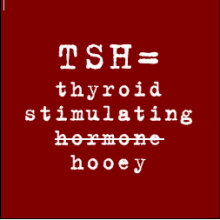
TSH = Thyroid Stimulating Hooey
[This post was originally published in 2009 and then updated in 2013 and 2024.]
I wish I had a dollar for every time one of my clients said, “My doctor tested my TSH and said that my thyroid is fine, but after reading your symptoms list, I’m thinking that I still have a thyroid problem.”
How can you be “fine” when you’re so exhausted and moody? And why is your hair falling out and your estrogen high? Why are you putting on weight and having a hard time losing weight despite your best efforts? Why are you lethargic, not sleeping well, constipated, and so sensitive to cold? Why do you have unexplained soreness and stiffness and mad cravings? Among other problems?
[Check out my #1 bestselling Essential Thyroid Cookbook: Over 100 Nourishing Recipes for Thriving with Hypothyroidism and Hashimoto’s.]
One of my past client’s doctor dubbed me “predatory” when my client showed this provider the functional thyroid panel I suggested she ask for (listed below). Her doctor emphatically stated that TSH was the only test my client would need. I hear this all the time (not the predatory part, the “TSH tells us everything we need to know” part).
Herein lies the glaring problem with conventional thyroid “treatment” and all of the people running around fried, cold, and overweight. True, being fried, cold, and overweight can be the result of other imbalances, but often times, it’s a thyroid problem that many doctors are clueless about how to investigate. By using old guidelines and limited thinking, conventional medicine glosses over the millions who suffer with low thyroid function.
If the thyroid is our master gland of energy and metabolism, and you’re fatigued and overweight, you owe it to yourself to completely rule out hypothyroidism by getting the full range of labs performed by a doctor who’s open-minded, understanding, and well-informed, not myopic and condescending. (Or I can order them for you.)
You can also perform a BBT test at home. Until the 1950s, when blood-based thyroid testing was developed, basal body temperature testing was how the medical community diagnosed thyroid conditions.
When it comes to thyroid labs, most doctors only check thyroid-stimulating hormone (TSH), which does not give a full picture of how the thyroid is functioning. Its nickname is Thyroid Stimulating Hooey (thanks for the funny moniker, Janie Bowthorpe) and many doctors are married to it as the single indictor of thyroid function. TSH tells you how your pituitary gland is talking to your thyroid, but tells you nothing of overall thyroid function. In fact, even the interpretation of this test is incorrect much of the time.
Truth be told, TSH isn’t wholly irrelevant, but it tells only part of the story. TSH increases when thyroid function drops and decreases when the thyroid is producing thyroid hormones. So you want low TSH. But many doctors believe that anything over 5.0 or sometimes even 10.0 is worth treating. This is crazy.
Alternately, according to many functional medicine doctors, anyone with TSH over 3.0 is hypothyroid. Some doctors claim that women tend to feel best with TSH between .3 - 1.0, although a general rule is .9 - 2.0.
But … “normal” or “low” TSH doesn’t necessarily mean that you aren’t hypothyroid. TSH is simply not the end-all-be-all for thyroid testing.
In addition to the recommended thyroid hormone tests, the list below includes the two tests for thyroid antibodies that would indicate the presence of Hashimoto’s (autoimmune hypothyroidism).
Getting doctors to recognize a thyroid problem, run the proper tests, know how to interpret those labs, and treat adequately is often challenging. If this is what you’re running up against, you may need a new doctor. Add to this the fact that most providers know little about how to treat an autoimmune condition, including Hashimoto’s, and patients’ hypothyroidism can still be mistreated.
Aside from LDN (low dose naltrexone), immune response modifiers, and biologics (a subset of immune response modifiers), there’s no pharmaceutical treatment for autoimmunity. So even if a doctor knows what Hashimoto’s is, many won’t test for it because their course of treatment wouldn’t change…they would do nothing differently for their patients.
LDN isn’t a cure for autoimmune conditions, but can help drive antibodies down. And please don’t get me started on immune response modifiers, which I would never call “treatment.” This eye-opening post is about biologics and alopecia, but it’s a highly recommended reading for anyone considering immune response modifiers. #blackboxwarning
You deserve to know if you have thyroid antibodies, which indicates thyroid tissue attack. It’s also been shown that once you have one manifestation of autoimmunity – any manifestation – if it goes unmanaged, the likelihood of developing yet another autoimmune condition is greater than 50%.
Many doctors will tell you that autoimmune conditions are lifelong conditions. Not necessarily true. And if you have Hashimoto’s and you’re simply trying to mask symptoms with hormone replacement, you’re barking up the wrong tree. Thyroid drugs can replace missing hormone, but they’ll never heal the thyroid.
Sometimes, doctors will run one antibody test without the other. What good does that do? If you end up getting tested for the antibody that you don’t have, it can be interpreted that you don’t have Hashimoto’s, when in fact you might. So it’s critical to have both tested. (Although it’s true that TPOAb is the dominant and most common antibody. Still, I’ve had clients with high TgAb and low TPOAb.)
“Doctors simply don’t understand very much about nutrition, metabolism, and the thyroid. They know the basic symptom list, they know how to do a thyroid stimulating hormone (TSH) test, and they know how to write prescriptions. But they don’t know about nutrition. You’ve heard the old bromide about how most doctors spend about an hour on nutrition in medical school. Well, in addition to that hour, they spend a couple of hours on thyroid disease, and that completes their education on nutrition and metabolism. The complexities of the endocrine system, the delicate interplay that goes on between hormones, the brain, the stomach, the appetite, and the ability to store and burn fat, are not topics most doctors have studies or even understand.” – Mary Shomon
* * *
Below are the labs I feel reveal the most about thyroid function. These values, along with much more information about driving thyroid hormone production and conversion and supporting the immune system with whole foods nutrition, is thoroughly outlined in my bestselling Essential Thyroid Cookbook.
Free T3 (or FT3) – T3 is “the big daddy” and the “free” in front of T3 (and T4, below) tells you what is available and unbound and therefore usable by the body. Without the “free,” the labs are only measuring the total of what’s there, which tell you nothing about what is available for use.
Free T4 (or FT4) - Again, tells you what’s unbound and usable.
Reverse T3 (or RT3) – The “anti-T3 hormone.” It can block thyroid receptors and cause patients to be unresponsive to any thyroid hormone. RT3 is typically high for those who need a lot of adrenal support.
TSH (thyroid stimulating hormone) - TSH should never be a stand-alone lab. It should always be taken in context with the above hormones and the antibodies listed below.
TPOAb and TgAb (Thyroperoxidase antibody and Thyroglobulin antibody) – These are the two thyroid antibodies tests. Positive antibodies confirm autoimmune thyroiditis (Hashimoto’s), although some doctors say that antibodies less than 30 are “indications” of Hashimoto’s and don’t point to a raging case.
I still feel that it’s best to walk through an immune-modulatory protocol and treat low levels of antibodies the same as if they were higher such that people don’t find themselves on the slippery slope of increased autoimmunity or MAS (multiple autoimmunity syndrome).
Important: Unfortunately, low or no thyroid antibodies doesn’t necessarily mean that Hashimoto’s isn’t present. Some people’s systems are fatigued to the point that antibodies aren’t circulating in the blood, even though they do have thyroid tissue attack (thyroid autoimmunity). Also, if systemic/cellular inflammation is raging, as is often the case with autoimmunity, the inflammation can mask antibody blood levels. So antibodies tests can sometimes provide a false negative.
Below are the functional medicine reference ranges. It’s important to compare lab results with these functional ranges vs. the old, outdated, conventional reference ranges that so many doctors are still using. And mis- or under-diagnosing with.
Free T3 (or FT3): 3.2 – 4.2 pg/mL
Free T4 (or FT4): 1.1 - 1.8 ng/dL
Reverse T3 (or RT3): 90 - 350 pg/mL or < 10:1 ratio RT3:FT3
TSH: 0.9 - 2.0 mU/L
TPOab and TgAb (Thyroperoxidase antibody and Thyroglobulin antibody) – A positive antibodes test indicates Hashimoto’s (autoimmune hypothyroidism). Generally, antibodies less than 4 is considered “remission” or managment of Hashimoto’s.
If you’re still experiencing hypothyroid symptoms, but you’ve been told you’re “fine,” or “borderline,” or told, “You don’t have a thyroid problem, eat less and exercise more” (terrible advice!), compare your labs to the above ranges. They may tell a very different story that what you were led to believe.
Comments
Unfortunately, all comments
Unfortunately, all comments on this post written prior to Feb. 28, 2013 were inadvertently wiped out. Ouch.
How is possible to get the
How is possible to get the FT3 that high in the range and NOT have the TSH completely supressed? On T4 only my FT3 never budged (wasn't converting) on Armour as soon as my FT3 came up over 2.0, my TSH was completely supressed AND my antibodies went up. What am I missing here?
Help! My TSH keeps going
Help! My TSH keeps going lower and lower (from around 2 to 0.2) and I keep gaining more and more wt. I have Hashimoto's, have NEVER weighed this much in my life. When I was in high school & college I was UNDERweight, now I'd be thrilled to lose 35 lbs, but weigh SEVENTY more than when I was in school. I have peripheral neuropathy, spontaneous angioedema, if that helps in diagnosis. I am 7 yrs. post-menopausal. I stopped periods abruptly & tests showed "no trace found" of estrogen, progesterone, or testosterone. MI'm eating less, exercising more (as much as I can), but I just get fatter & fatter. My new GP wouldn't renew my testos./proges. prescrip, said women need to only be on it a few years. (Old dr. wouldn't prescribe estrogen, b/c at 74 my mom had breast cancer. The cancer was the size of a grain of rice.) Help, I'm tired of waddling!
Hi Anonymous, We're so sorry
Hi Anonymous,
We're so sorry to hear of the struggles you've been having. The issues you've described have been all-too-common among the client we've worked with. If you're interested in chatting with us, go to our Contact page to submit an inquiry or let us know if you'd like to be put on our waiting list for an introductory session when our schedules open up in early 2014.
Hi there! I'm 53, post
Hi there! I'm 53, post menopause,diagnosed hypothyroid at 25. I was on 150 mcg levothyroxine for 20 years. Never felt great. Last year Dr. lowered dose to 125mcg. I started feeling worse and loosing hair but she insisted my levels were fine and suggested I go back on anti depressants that I had stopped 3 years ago since they didn't help. I declined. I started taking nascent iodine and felt great for a few weeks but then got sick. I thought I would just ween off synthroid and see how things went. I crashed. I had an appointment with a chiropractic neurologist who treats thyroid issues and the Dr. ran all the test you recommend. My TSH is 557! (Not a typo) I feel very fatigued. At about the time I crashed which was 6 weeks without synthroid, I caught a virus that four other family members had. It became hard to tell what was causing what. The bloodwork came back and I was told I needed to see my MD and get back on synthroid. I tested positive for Hashimoto. TPOab is 212, TgAb 10.50. FT3 and FT4 are functionally very low. That said, I just want to know if there is any hope for my thyroid to restart or did I just really screw up? I have to function more but I have to say that I don't feel as awful as I should given my numbers. I just don't want to stress out my body anymore if there is no hope for my thyroid. I'ld appreciate your timely response. Thanks.
Hi Maria, Thank you so much
Hi Maria,
Thank you so much for your comment, but I am so sorry we are just now responding. Yes, indeed, your lab values suggest you thyroid function is severely compromised, but there is always hope for improved thyroid function. There are several strategies that can be employed both with respect to your diet and lifestyle that will nourish your thyroid and tame the autoimmune attack against it. There are also many different medication options, and they are not one-size-fits all. Please be careful of supplemental iodine -- many in the functional medicine community advise that for people with autoimmune hypothyroidism (Hashimoto's), it's like throwing gasoline on a fire.
Clearly, your individual body presents unique and complex challenges to reaching optimal health, and there are many factors that it's difficult to touch on via blog comments. If you would like to speak with us about your situation, you can email us via the Contact page.
Warmly,
Mary
Is it normal for your thyroid
Is it normal for your thyroid levels to be constantly in flux? I was diagnosed with Addison's disease 20 years ago, hypothyroidism 15 years ago. I am constantly being told that my dose for hypothyroidism is too low this month, too high that month, needs to go up, needs to go down, all by the same doctor. A few months ago I was put on 300mcg/day and told I would probably need Armour. A month ago, I was in the ER with a racing heart and told that was far too high for my needs and to cut down to 220mcg. Then I was told that too was too high but to maintain it. I have put on 18 pounds this month (month, 30 days!) with no change in my normal diet or routine, have a huge swollen goiter that creates a sore throat so bad I cry most days, sleep 20-22 hours out of the day, avoid washing because I am too tired to take a shower...and am told that my dose is way too high?? All my doctor ever looks at is the TSH, never considering my energy level or other tests. Is this typical? It's been this way for two years. Before that, I couldn't get health insurance so hopped from ER to ER and kept to around 180mcg.
Hi Karen, I'm so sorry to
Hi Karen,
I'm so sorry to hear what you've been going through. I can't imagine how frustrating it must all be for you.
Thyroid lab values can vary greatly -- they are only a snapshot in time, reflecting what you numbers were the moment your blood was drawn, but can vary throughout the day or month. Many functional medicine practitioners prefer to dose based on symptoms, rather than relying on lab results alone.
It's very difficult to give you specific advice via blog comments, but know that there is a very close relationship between thyroid function and adrenal function. There are many other factors that could be impacting your thyroid function as well, and there are many dietary and lifestyle strategies that can bring about improvement. If you are interested in speaking with us, please feel free to use the form on our Contact page.
Warmly,
Mary
I am a 67 yr old new widow...
I am a 67 yr old new widow....what was left of my thyroid after a lump removed was absorbed by my body. I'm also a heart patient. Also have arthritis in many joints. Meds for thyroid don't seem to help with weight loss and fatique. I will lose wt. when I drink hi protien drinks and no solid food. Add solid food and wt. comes right back. Was down 15, 8 came back. Post menpasl, 15 years. Is there a specific specialist I should be going to, besides my regular ones. Can you have Hashimotos with no thyroid?
Hi Mary, I’m very sorry to
Hi Mary, I’m very sorry to hear about your loss. It’s not uncommon for thyroid meds to be unhelpful. I’m not saying they’re all bad in all situations, but there aren’t a lot of success stories. Inflammation and autoimmunity go hand-in-hand; if you have Hashimoto’s and walked through an immune modulatory program, you would very likely see arthritis relief. If you have little or no thyroid tissue, that doesn’t mean that the autoimmunity has been addressed – you can still have antibodies. Please don’t do a liquid diet. :)
Hello, thank you for being
Hello, thank you for being available for advice. I am a 25-year-old female feeling like I'm 95 (although probably many elderly people have more energy than me). I had my thyroid tested 5 years ago after I fainted out of nowhere. The results were not normal but as my doctor said: "not abnormal enough to treat"... Well, forget the numbers if I'm still feeling exhausted and depressed, right? (There is a history of low blood pressure and thyroid issues in my family; my grandma has Hashimoto's) They also tested me for anemia, which I didn't have, and they also did what's called the tilt table test to check for orthostatic hypotension, and I fainted (even my heart stopped for a couple of seconds). Not much was advised other than taking midodrine (which I don't) and using more salt, which I do. Five years have passed and not much has changed. I've been doing a ton of research on the subject lately, but I do not have the money to see someone right now and do comprehensive testing. What I have been doing on my own though is working on my anxiety and mood swings (which I have had ever since I can remember), eating more healthy and regularly, going for walks, taking vitamins, sleeping, drinking more water, and cutting down on sugar. I basically have a question about the relationship between the thyroid, the adrenals, the pituitary, and the hypothalamus. I've noticed that it's emphasized how the adrenals (which I am 100% sure are messed up in my case) need to be addressed before the thyroid, but why don't we look higher up there for the solution? So, why do we fix the adrenals before the pituitary gland and the hypothalamus, and whatever else guides this whole interaction? Isn't there an obvious link between them when there is a metabolic dysfunction? Please explain how that works and tell me what you think I can do as I am, for now, trying to tackle this on my own. Thank you!
Hi Eva, well, you ask great
Hi Eva, well, you ask great questions. It’s difficult to give you thorough answers in a blog comment, but generally, it’s not so much that you address the adrenals before the thyroid. Our suggestion is to address them simultaneously. If you have Hashimoto’s (97% of people with hypothyroidism do), you also want to address the immune system via an immune modulatory protocol, which is the “solution” for most people’s low thyroid function. But yes, the adrenals play an important role as well. “Fixing” the adrenals helps to ease the burden on the hypothalmus, which is very stress-sensitive and as you likely know, the adrenals produce stress hormones. These hormones can actually save our life; it’s the overproduction of these hormones that we need to worry about. Nourishing and supporting the adrenals helps to modulate the HPA axis (hypothalamic-pituitary-adrenal) and HPT axis (hypothalamic-pituitary-thyroid) axis.
Here's an interesting twist
Here's an interesting twist on this. Where I live (south-east England), even if the GP (family doctor) can be persuaded to run more than a TSH, the hospital testing lab then refuse to run the tests he has requested. I cannot get over what a crazy mixed-up world it is, where a lab who have never met me or had any knowledge of my symptoms can dictate what may or may not be wrong with me, without even checking. Now that my specialist endo has said he can do nothing more for me, I no longer have annual access to his labs. I am therefore completely reliant on my GP (as Eva remarked, private comprehensive testing is prohibitively expensive). There is such a mountain to climb, here. Please keep up the good work, so that I can take it to my GP in hopes for better.
i was diagnosed with
i was diagnosed with hypothyroid after years of fatigue ,brain fog and weight gain!
all around menopause time which I initially put done to that!
treated with natural thyroid product and had 6 fabulous months !
then was convinced by my gynae to have a rosy roger implant!
im terrible again ,exhausted ,no brain it feels !
What can I do???
Hi Fran,
Hi Fran,
We are so sorry to hear of the troubles you’re going through. We know that can be so frustrating.
Your question and collection of symptoms represent a complex condition and cannot be answered responsibly on a blog comment. We’d love to help you – if you’d like to speak with one of our coaches, you’re welcome to schedule an introductory session via our Contact page.
http://www.healthfulelements.com/contact
Warmly,
Blair
Hi. I have been diagnosed
Hi. I have been diagnosed with sub-clinical Hypothyroidism. High TSH (11) but T4 within normal ranges. i have some of the symptoms (tiredness, dry skin, constipation) but not too serious and these could be due to advancing age? (i'm 55 and have had these symptoms for 8+ years). My GP says i should take thyroxine. I have a healthy diet and exercise well. Please help. LJ
Hi Linda, I don’t offer
Hi Linda, I don’t offer individualized guidance on this blog, but TSH of 11 is quite high. T3 is a better indicator of thyroid function than T4. And 55 is young?!
Hi I am 52. My TSH levels
Hi I am 52. My TSH levels have been getting lower and lower. However my free t3 and t4 remain in the middle of acceptable range. I have lots allergies to foods and chemicals. I am 2 years post menopause which was pretty uneventful. My doctor says test TSH again in 1 year! Does this seem ok? Am I heading for hashimoto's? I am living in a very stressful situation so feel exhausted and edgy. I can cry at the drop of a hat. My facial skin is so so sore. I have not eaten out or eaten anything but unprocessed foid for 15 years. I have liitle iodine in my diet apart from what I get in himalayan salt. Could this have caused my problems. Feel unable to continue some days
Add comment